Walking Ancient Paths 2001
Background
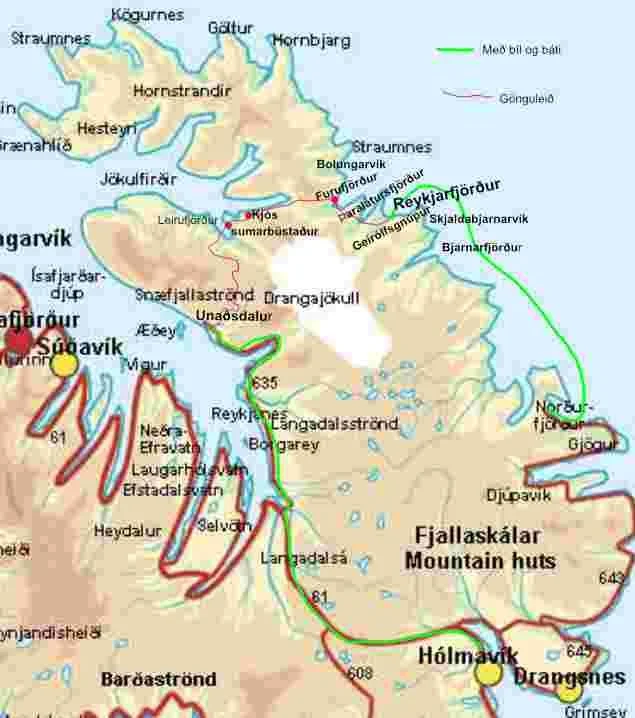
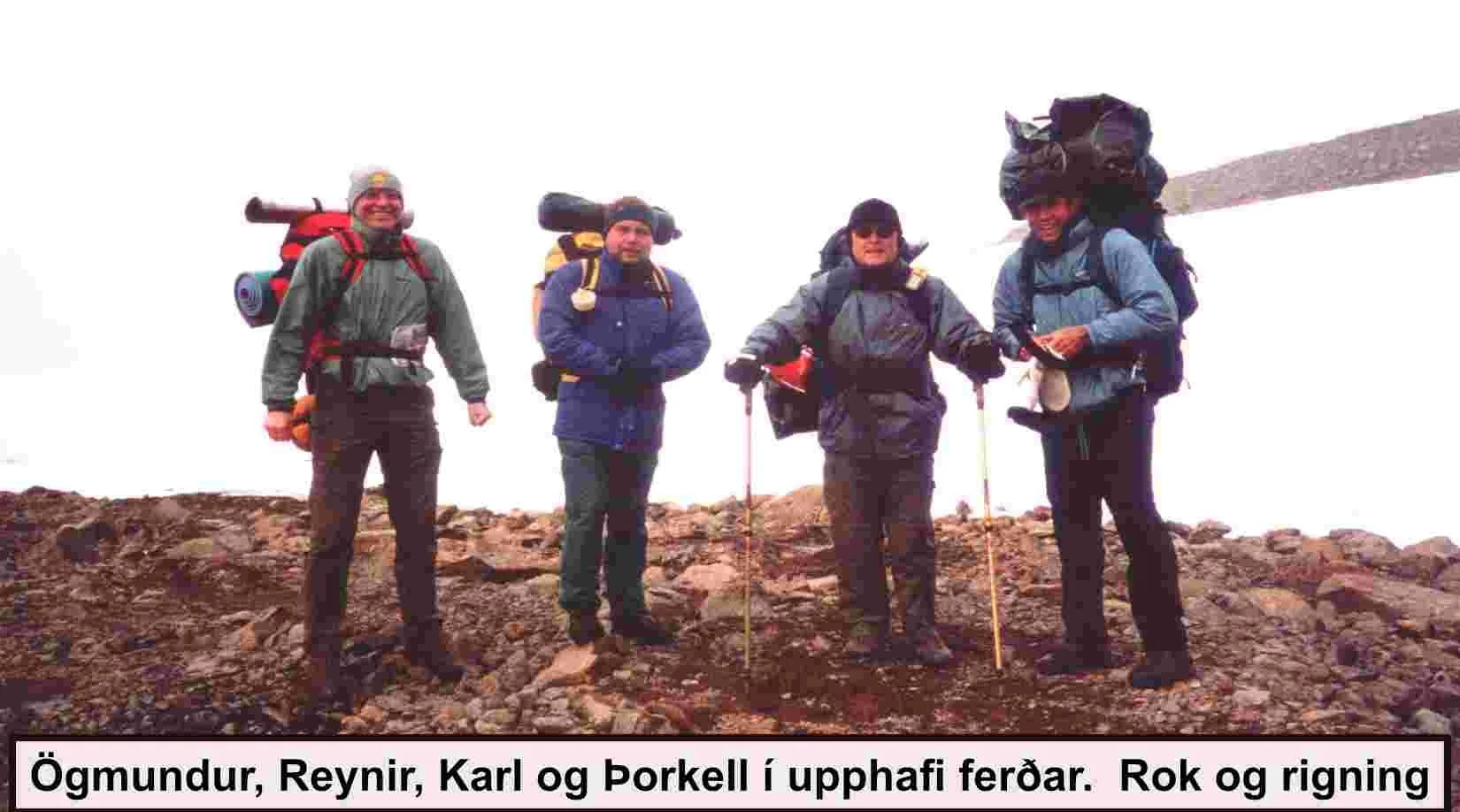
Þorkell Jóhannsson, Ögmundur Gunnarsson, Reynir Engilbertsson and Karl Valgeir Jónsson, all teachers at Garðaskóli in Garðabær, set out on a hiking journey from Unaðsdalur by Ísafjarðardjúp to northern Reykjarfjörður in the Strandir region, carrying all their equipment on their backs. What follows is a description of this four-day hike. The account was written by Karl Valgeir.
From Unaðsdalur – Monday, July 23
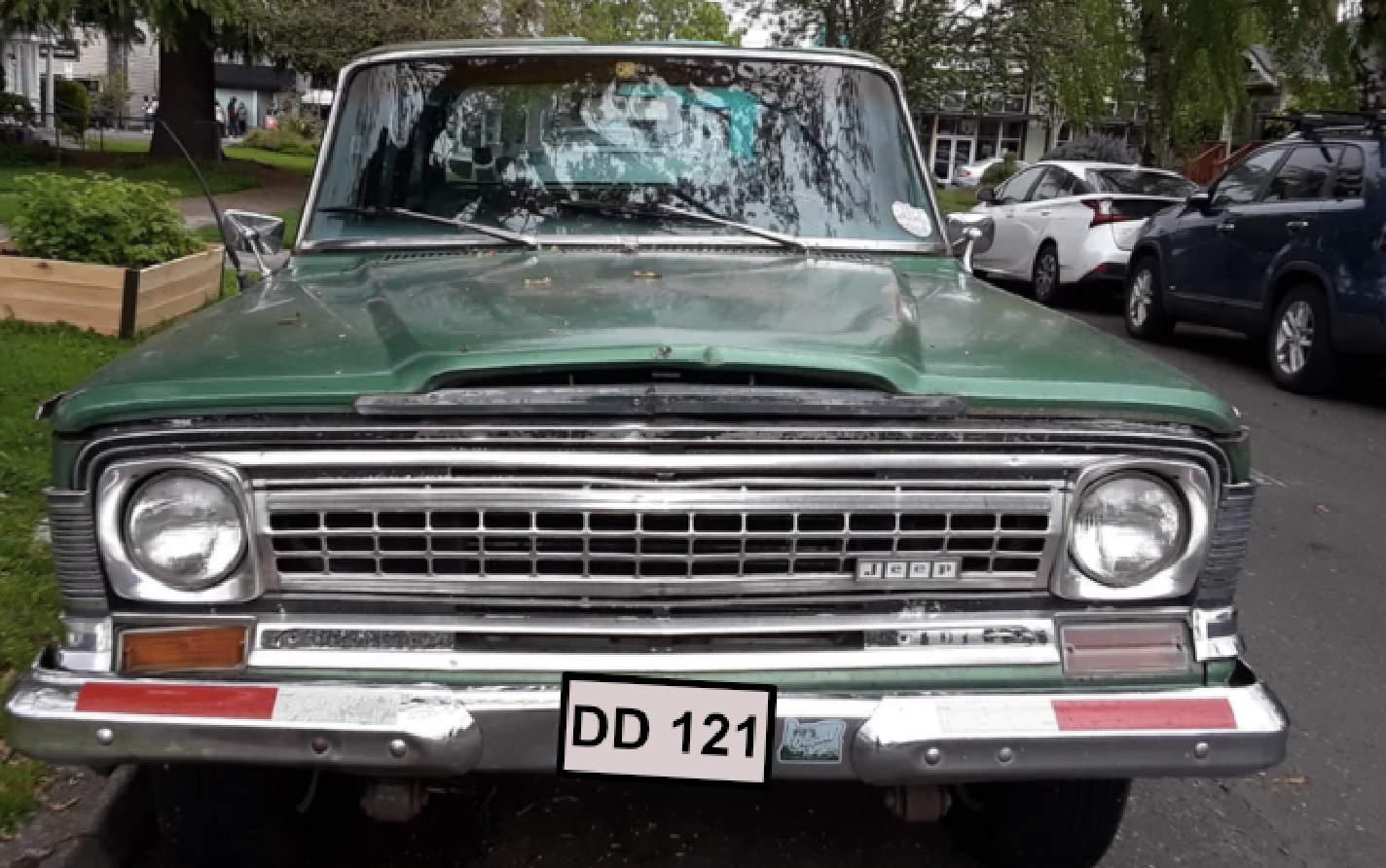
We drove straight to Hólmavík in the fishing vehicle DíDí and made an “invasion” of the home of a certain Ingimundur Jóhannsson. Ingimundur is the brother of our fellow traveler and seasoned hiker Þorkell. Ingimundur then drove us in his own car from Hólmavík to Unaðsdalur, taking us as far up onto the heath as conditions allowed. The track ended at a large snowdrift at approximately 320 meters elevation on Heimstafell, on the side of Miðfell.
At this point fog had descended, visibility was about 100–150 meters, and steady rain was falling.
The time was around three in the afternoon, and under these unpleasant conditions we set our course for Dynjandisskarð. The GPS indicated a distance of just over 5 km in a straight line. We said goodbye to Ingimundur; he did not seem to envy us the situation we were heading into.
Aside: Ingimundur also arranged to have our vehicle (DíDí) transported from Hólmavík to Eyri at Ingólfsfjörður. He and his wife deserve special thanks for their exceptional hospitality and this invaluable assistance.
We chose to walk as much as possible on wet snowfields, but in between we crossed what must be one of the largest boulder fields I have ever seen. Each rock slab seemed worse than the next, often standing on edge, and every step had to be carefully chosen. I broke one of my trekking poles in this difficult terrain on Öldugilsheiði. The walk to Dynjandisskarð took just over two hours.
Upon reaching Dynjandisskarð—guided precisely by our GPS units—we found both stone cairns and abandoned telephone poles that had been erected there in earlier times. As we descended lower into the pass, the weather improved somewhat, and eventually Leirufjörður and the farm Dynjandi came into view. However, it was still not bright enough to spot Flæðareyri, which lies slightly farther north on the western side of Leirufjörður. At this point Ögmundur had lost the map with the GPS waypoints, but fortunately we had spare copies.
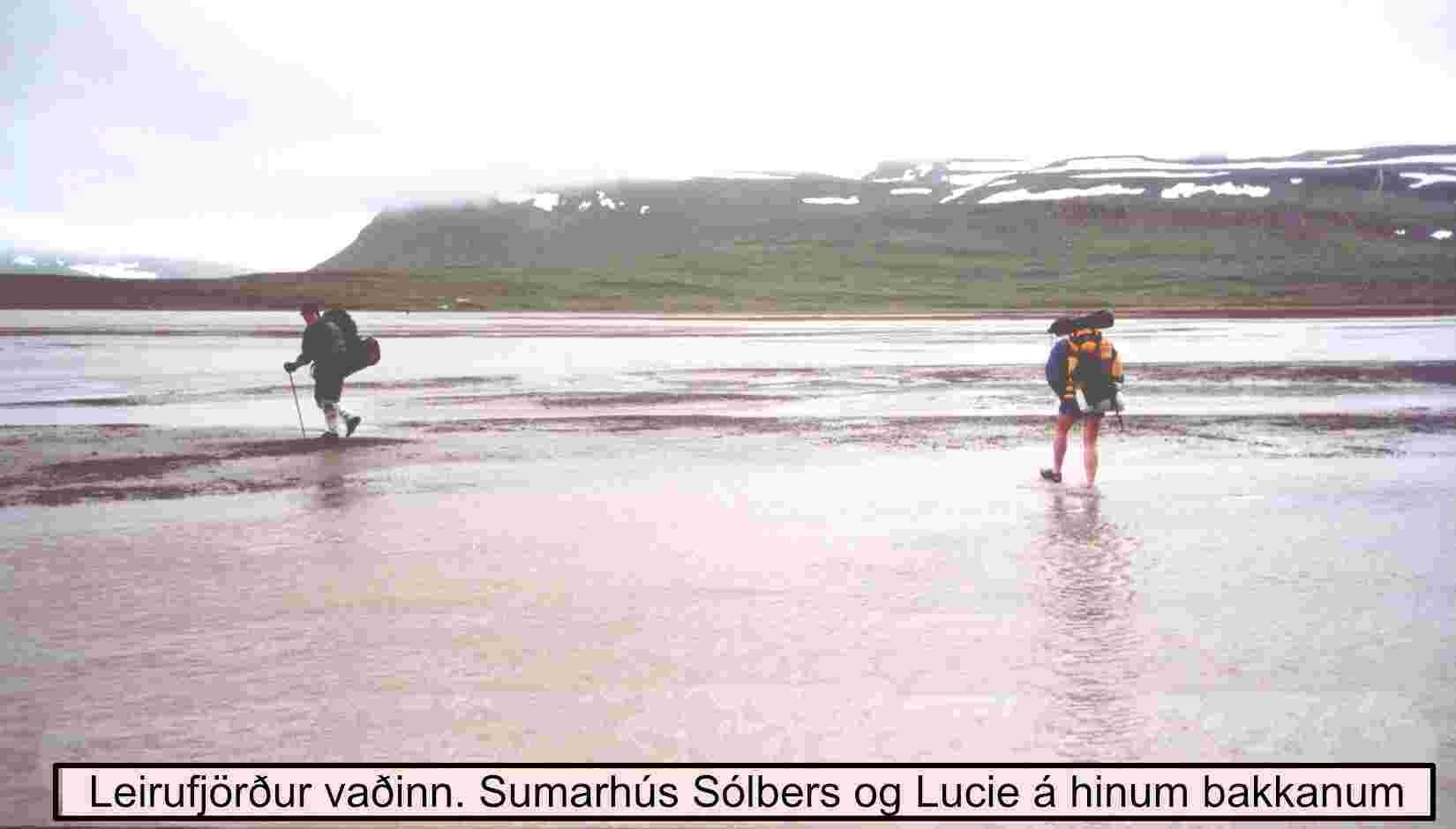
The next GPS point was Kjós, a small inlet off Hrafnsfjörður. After passing the shoulder of Hádegisfjall, the bottom of Leirufjörður came into view, along with a summer cabin standing on the bank of an unattractive glacial river known as Fjörðurinn. It had flooded nearly the entire valley floor. We had to wade this dark, muddy river, something we had been dreading. We chose to cross higher up the floodplain, as the water was somewhat shallower there. The width of Fjörðurinn—a confluence of Jökulsá, Öldugilsá, and Landá—was close to one kilometer.
The river was murky, shallow, and treacherous underfoot. We had to pick our route carefully to avoid sinking into the mud. Gravel bars allowed us to move up or down the river to find the most manageable crossing points.
By this stage some of us were soaked up to our feet, or even to the waist, as footwear and trousers varied greatly in water resistance. Þorkell quickly changed into his wading shoes (light canvas shoes) and otherwise crossed barefoot. He chose the route with great skill. The rest of us did the same, except that Ögmundur and I kept our trousers on, putting our feet into salmon bags and then into our wading shoes. Reynir crossed barefoot like Þorkell, but unfortunately his wading shoes were sneakers—poor equipment, as sand and small stones got inside and left him sore-footed.
After crossing, we investigated the summer cabin on the riverbank. Þorkell was the first across, had already changed back into his trousers and hiking boots, and knocked on the door. It was a great encouragement for the rest of us, wet and cold, to see that there were people inside who invited him in.
The couple in Leirufjörður were truly angels sent from heaven to revive us. They were Sólberg and Lucie from Bolungarvík (Sólberg is a former savings-bank manager there). They own the land at Leirufjörður and Kjós. The welcome from this wonderful couple was extraordinary. We were stripped out of our wet clothes, which were hung to dry over a hot Sóló stove. We ourselves sat lightly clothed in front of a powerful gas heater, warming our icy feet after the glacial river crossing. We were served hot coffee with kleina pastries and various kinds of biscuits. We stayed there for about two hours, roughly from 7 to 9 p.m., and recovered our strength considerably.
We then continued on to Kjós with the intention of camping there. We felt much better, the rain had mostly stopped although the sky was still heavy, but our backpacks were soaked and felt unnaturally heavy. Unfortunately, views and mountain scenery were very limited, and it was hopeless to take decent photographs—though the story is accompanied by some remarkably successful photos from the trip.
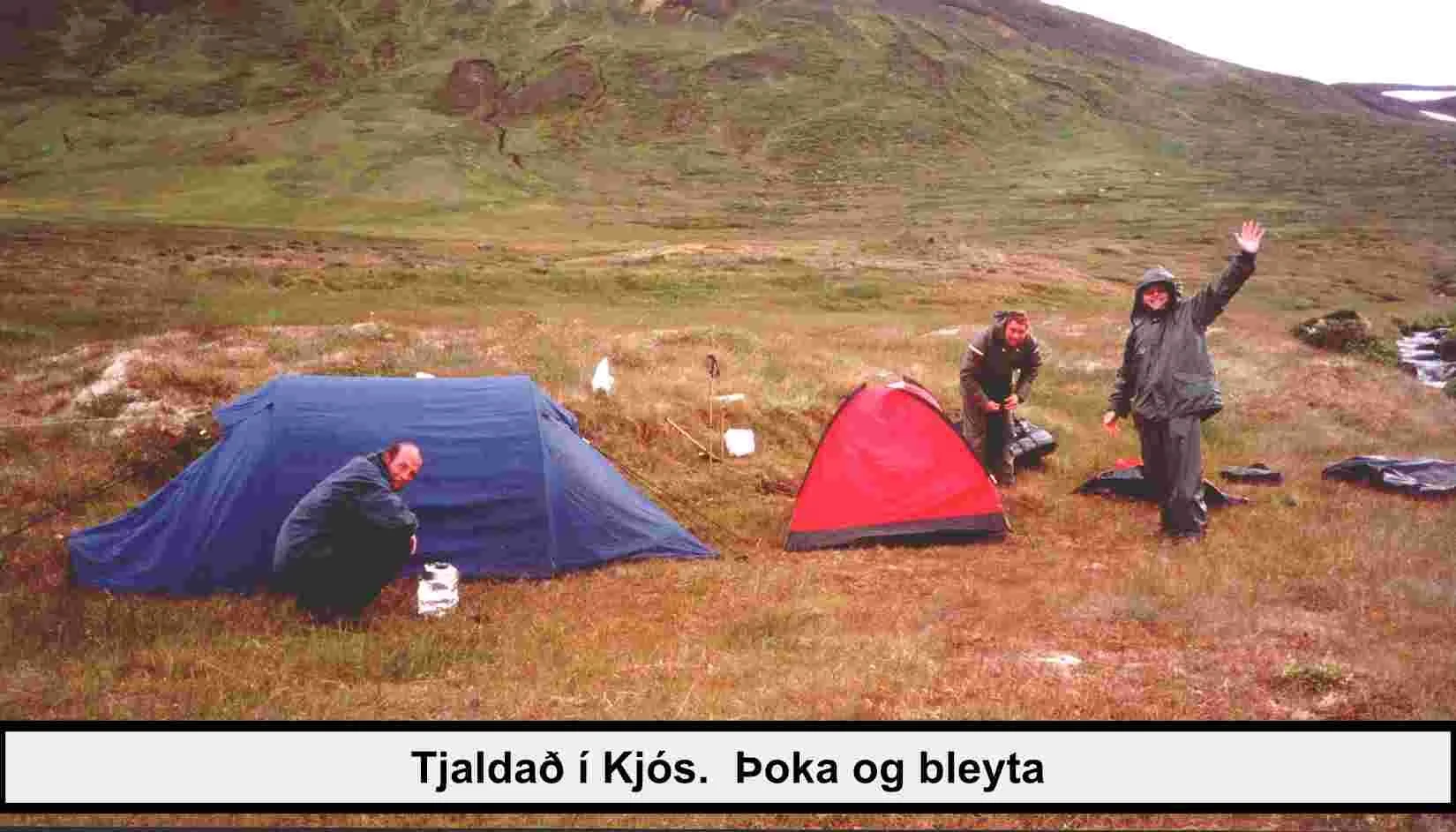
At 10 p.m. we pitched our tents in Kjós, heated our evening meal, crawled inside, and attempted to sleep. Reynir and I did not sleep well, as heavier rain fell during the night and the tent was not sufficiently waterproof. Fortunately, it was relatively calm. Our sleeping bags did not get seriously wet, but the situation greatly hindered a good night’s sleep. Ögmundur and Þorkell, however, slept well, as their tent was top-class.
From Kjós – Tuesday, July 24
We got up around 7:30 a.m., heated soups and noodles, and ate well—more out of necessity than appetite. After pulling on wet shoes and socks and hoisting our gear onto our backs, we set off toward the head of Hrafnsfjörður. It was drizzling and foggy, with very limited views, as before. However, there was a path along the banks and shoreline that was easy to walk.
After about 8 km, or just under three hours of walking, we reached the rescue shelter at the head of Hrafnsfjörður. Along this route are several spring-fed streams, which were swollen at the time, and in places it was slow work to find safe stepping-stone crossings
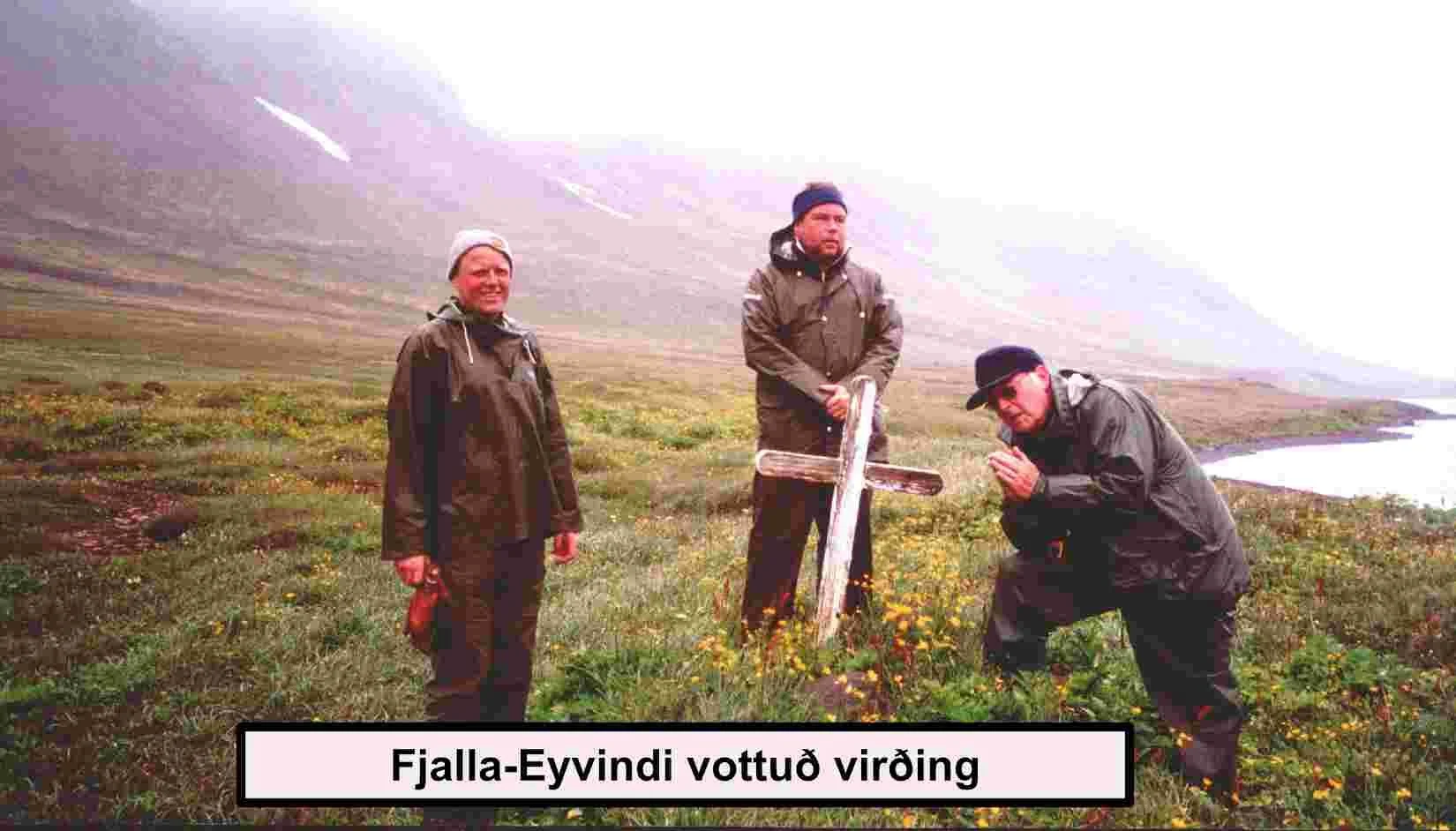
We examined the ruins at Hrafnsfjarðareyri and Skipaeyri and paid our respects at the grave of Fjalla-Eyvindur. The accompanying photograph shows this moment. Þorkell took the picture.
In the shelter we heated lunch, as it was now noon. Noodles were on the menu, followed by hot cocoa with biscuits. After a good rest we began the ascent of Skorarheiði. We first followed the river formed by the confluence of a substantial glacial river coming from the right (south) out of the pass and a much smaller spring-fed stream, Skorarár, coming from the left (east)—a point shown inconsistently on some maps. On the left stood a beautiful rock formation called Gýgjarsporshamar. A large, well-built arched bridge crossed the river, and from there we followed the hiking path up onto the high heath to Skorarvatn, at roughly 200 meters elevation.
Here we attempted to get phone reception on my NMT mobile phone, unsuccessfully. No connection had been made since we were on Öldugilsheiði above Dynjandisskarð.
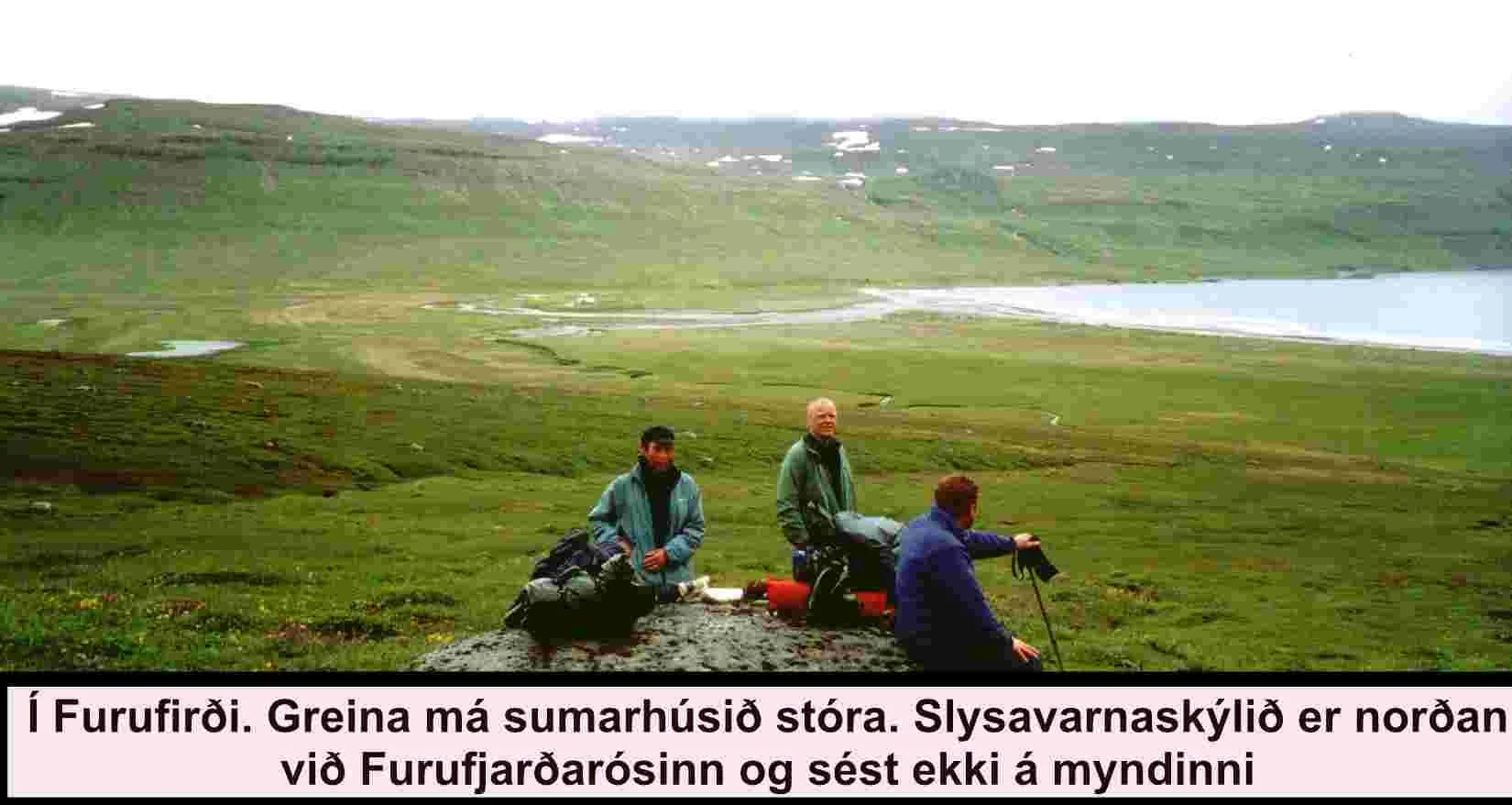
Through the fog we now glimpsed a wide valley and a fairly broad fjord—this was Furufjörður. Its beauty was hard to discern in the gloom, though one could imagine it on a fine day. The valley was grassy but marshy, with many streams and small rivers flowing from its slopes. Down the middle ran the glacial river Furufjarðarós, dark, muddy, and unpleasant.
By about three o’clock we faced a choice: either skip Furufjörður and continue along the clear mountain path on the right (east) side, gaining altitude toward Svartaskarð (440 m) and from there to Þaralátursfjörður and Reykjarfjörður; or stop for the day, descend into Furufjörður, and spend the night in the rescue shelter there.
We chose the latter, even though steaming meat soup awaited us in Reykjarfjörður. We were simply too wet and cold to continue, despite our original plans. On the descent we tried to stay on the northern slope to avoid marshes and quicksand, but the route was still wet and unpleasant. Many streams flowed from the hillside, some impossible to cross without wading. By this point it hardly mattered—we were soaked up to the knees anyway.
In Furufjörður we found a spacious, well-equipped rescue shelter, much larger than the one at Hrafnsfjörður. It had cooking facilities and an oil heater with lines for drying clothes. We began to feel better. The evening was spent drying ourselves, trousers, shoes, and socks, as well as cooking and eating dinner. Þorkell then made sure that Captain Morgan lulled us comfortably to sleep early that evening (7:15 p.m.).
Wednesday, July 25
We woke early, around 6 a.m., finally well rested. Rain had stopped and the sky was much brighter. After heating noodles and soups, buttering flatbreads, and packing our gear, we set off. Socks and trousers had mostly dried, and the boots had recovered enough to be treated and partially waterproofed.
We headed toward the mouth of Furufjörður, following the shoreline. Like most glacial rivers, Furufjarðarós was dark and icy, but not fast-flowing or very deep early in the morning. We waded it in the same manner as the river in Leirufjörður. This river was narrower, so the cold was quickly endured.
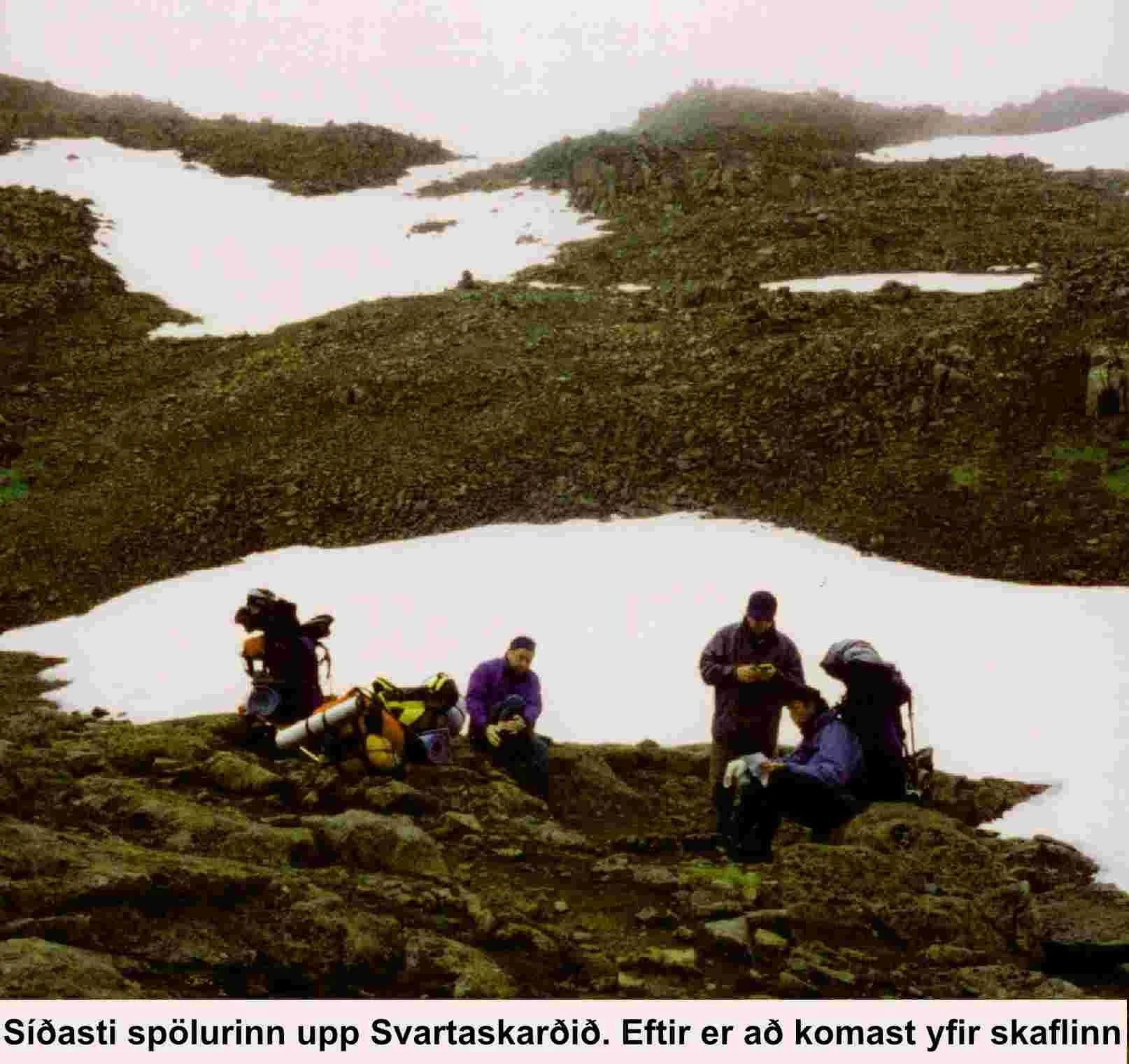
After drying our feet and putting our hiking boots back on, the formidable ascent began. The previous evening we had met people in a massive log house in Furufjörður who vaguely indicated where Svartaskarð was, pointing to a snowdrift high on the mountain. The mountain had vertical cliffs high up the steep slope, with snowfields above them. Climbing this with 17 kg on our backs would clearly be a severe test.
It took us more than three hours to climb the steep 440 meters, with enormous water consumption. What madThe
There was a clear, well-cairned zigzag trail. We were amazed to see that horses had traversed this route, as hoofprints were visible even across a substantial snowdrift near the top. These climbing horses must be descendants of the glacier horses once used to haul driftwood across Drangajökull in earlier times. Later we learned that a tour operator now offers to transport hikers’ luggage over these mountains for a reasonable fee.
We eventually made it up without outside assistance, taking many breaks. Our rule was to rest thoroughly for every 50 meters of elevation gained.
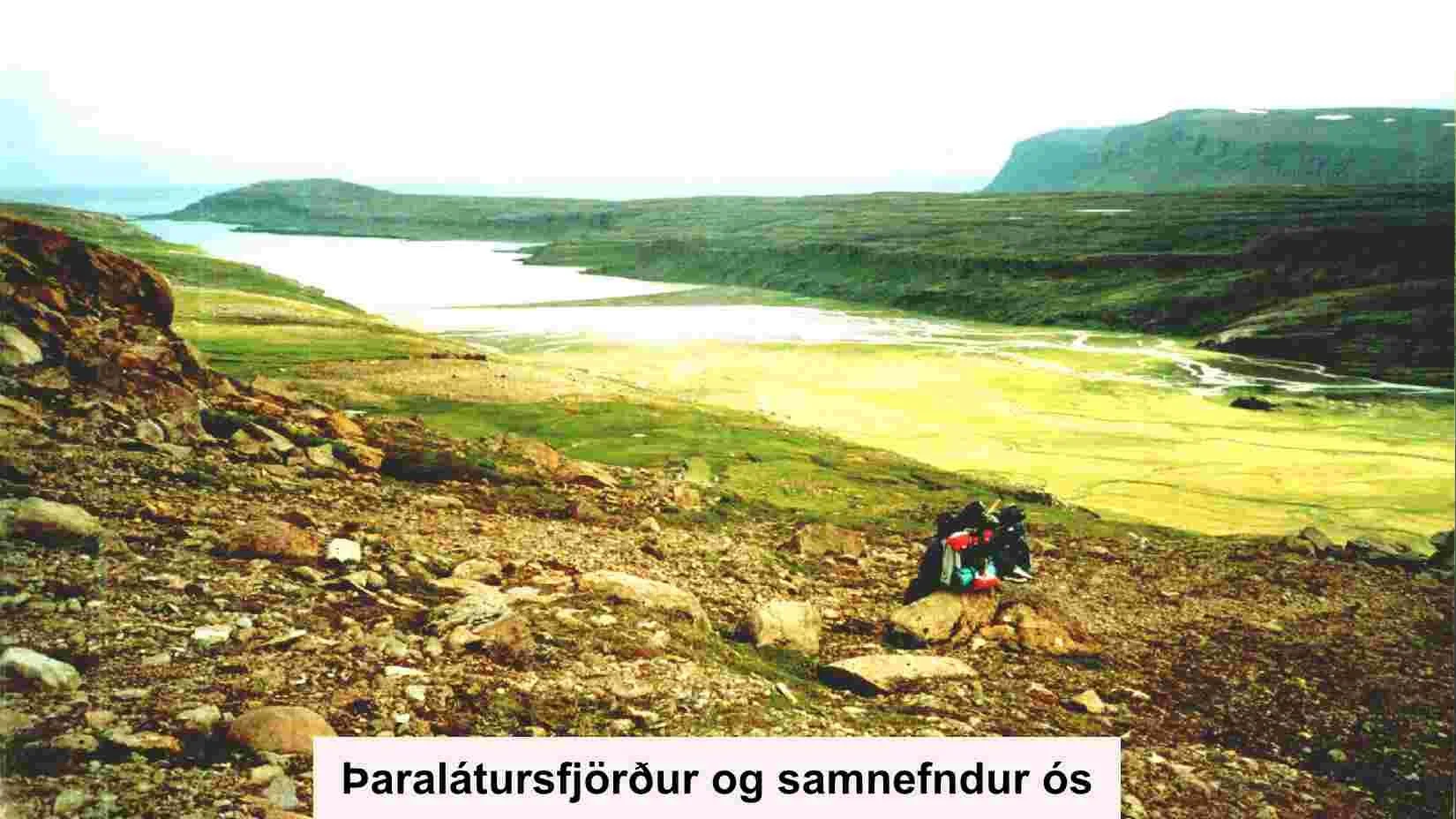
At the top the view was excellent, and our spirits lifted greatly. There was strong phone reception, and we called Reykjarfjörður to announce that we were on our way to the meat soup, albeit a day late. We also called home, each of us, describing the hardships of the past days. After brief conversations we continued along the good hiking trail down into Þaralátursfjörður. The weather was now quite good, and the fjord struck us as very beautiful. In the middle ran Þaralátursós, which we waded in our wading shoes as before. It was fairly wide, with gravel bars in between, but the bottom was firm and the crossing went smoothly.
On the far bank we let the sun dry our feet while we had a light meal (crispbread with toppings) and water. We did not want to eat much, knowing that meat soup awaited us in Reykjarfjörður.
From there we climbed gently over a low pass (about 150 m) into Reykjarfjörður. Þorkell was eager to stretch his legs and took off at a run, reaching the destination about half an hour ahead of us.
When the rest of us arrived, he had already informed Erla—one of the landowners of Reykjarfjörður—of our arrival, and she had the meat soup on the stove. He had also been assigned a campsite and had even pitched his tent.
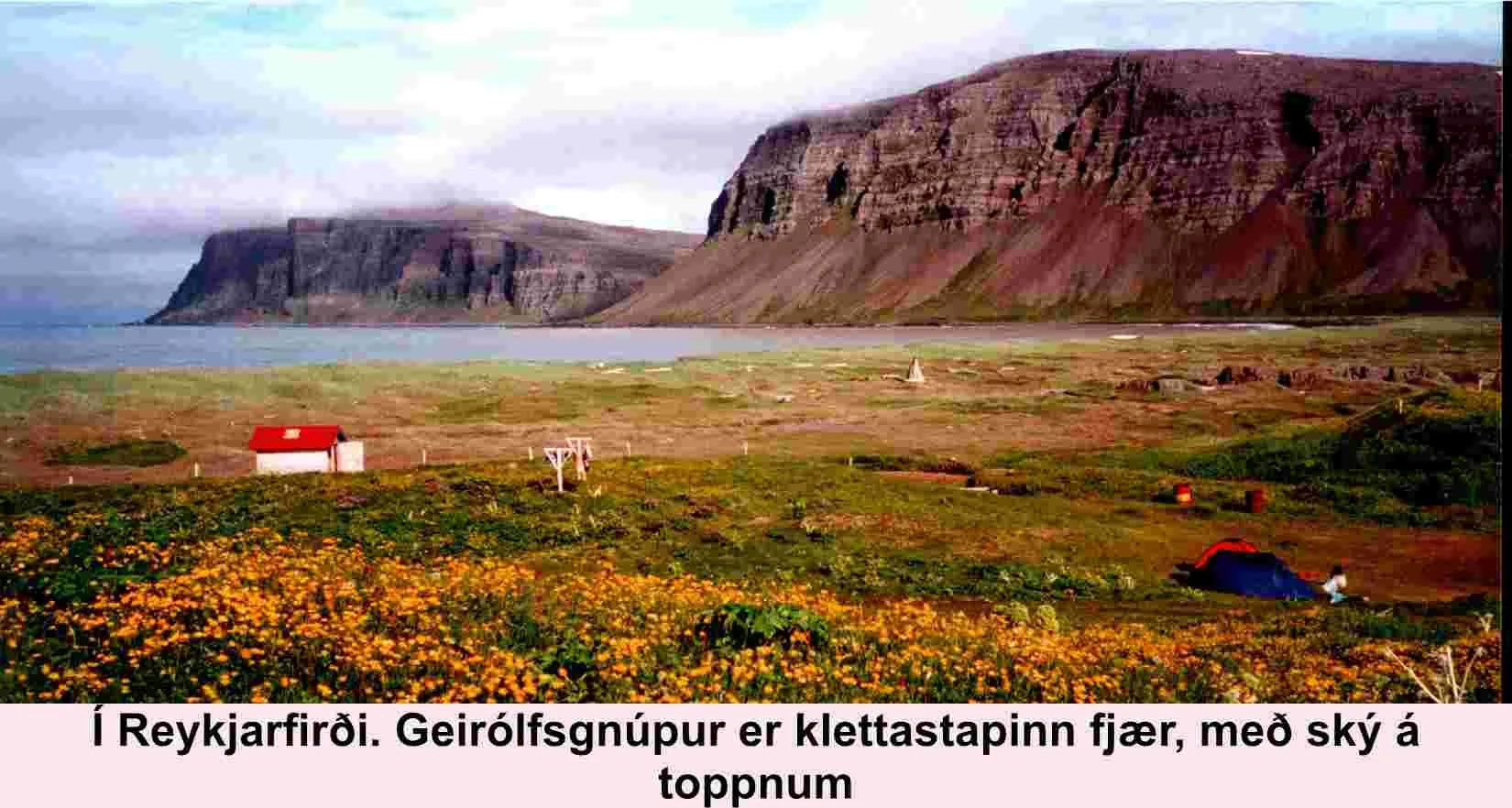
Arriving in Reykjarfjörður in sunshine and calm felt like entering paradise itself. We greeted the landowners, Ragnar and Sjöfn from Bolungarvík, along with Erla. They were busy preparing for Ragnar’s 70th birthday, to be celebrated three days later. We pitched our other tent (if it could be called that) and then went swimming in the remarkable local pool. After that came the famous meat soup, reheated from the previous day. It was exceptionally good, as were the flatbreads that accompanied it. While we ate, Erla told us the history of the place and explained local conditions. A dead fox lay by the door of Ragnar and Sjöfn’s house, and a fox cub played nearby with the children. An airplane carrying tourists and supplies landed on the local airstrip. The boat Húni from Blönduós docked and disembarked passengers, and the boat Sundhaninn from Norðurfjörður called in on its way to Hornstrandir.
There were not many visitors, as most were relatives attending the birthday celebrations and thus not staying at the campsite. Two tractors were constantly moving between the airstrip and the pier, and the patriarch himself, the birthday celebrant, sped back and forth in a Toyota Hilux on 38-inch tires. When we asked how all this machinery had been brought in, we were told that in spring it is easy to drive over the glacier and down into the valley on snow, given the right equipment.
Thursday, July 26
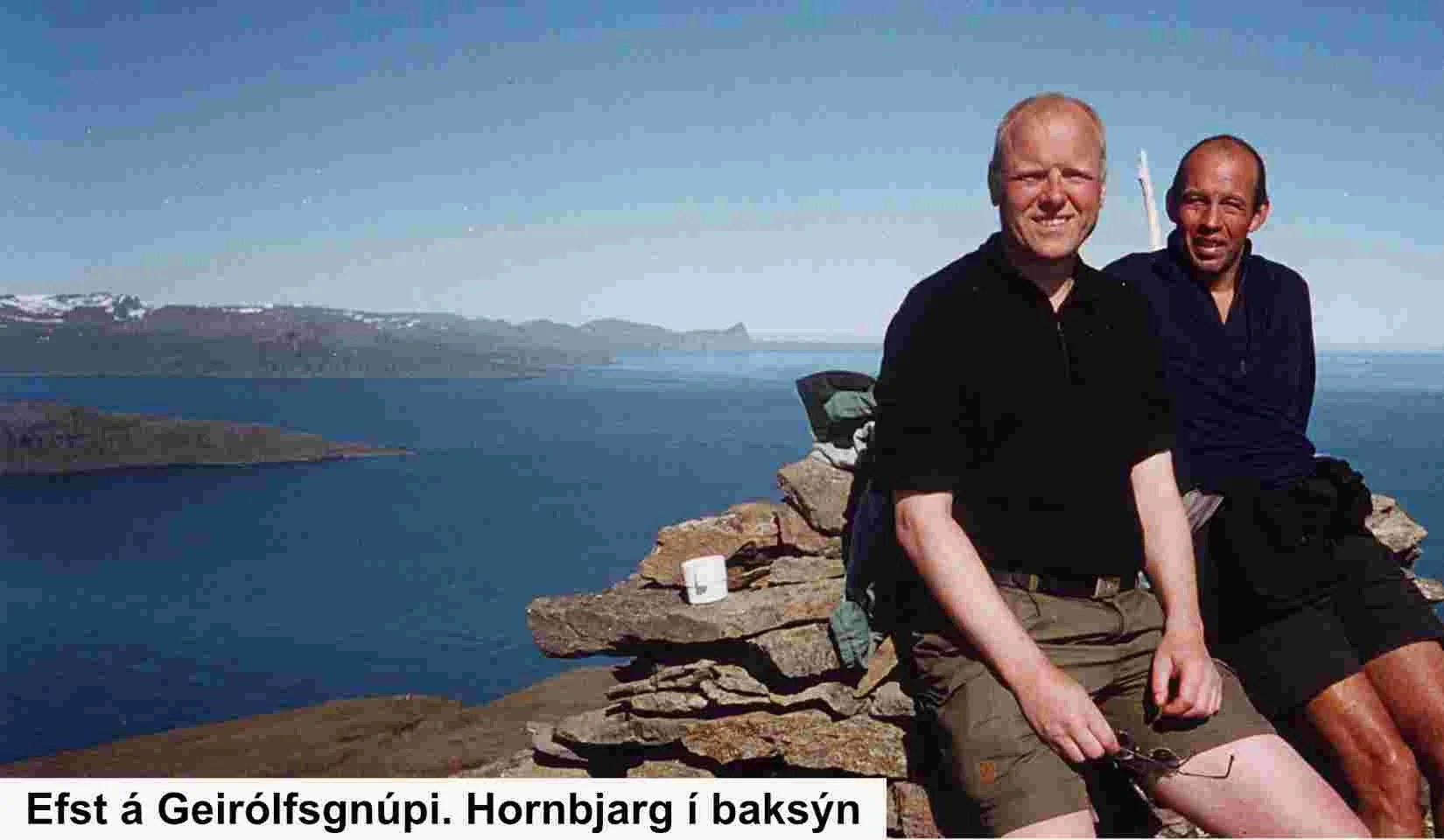
We woke early to brilliant sunshine and calm weather—everything was as perfect as one could wish. After breakfast we decided on a light mountain hike up Geirólfsnúp, or Geirhólm as locals usually call it, at 433 meters elevation. We planned to go without backpacks and return to Reykjarfjörður. The hike was estimated at about five hours, fitting well with our plan to catch a ride with Sundhaninn to Norðurfjörður around 4 p.m., from where our car awaited us at Eyri by Ingólfsfjörður.
To reach the mountain we first had to wade Reykjafjarðarós, the largest glacial river we had yet crossed. By now we were accustomed to such crossings and did not hesitate in the sunshine. It went well. After some distance Reynir decided to turn back, as his shoes were causing problems.
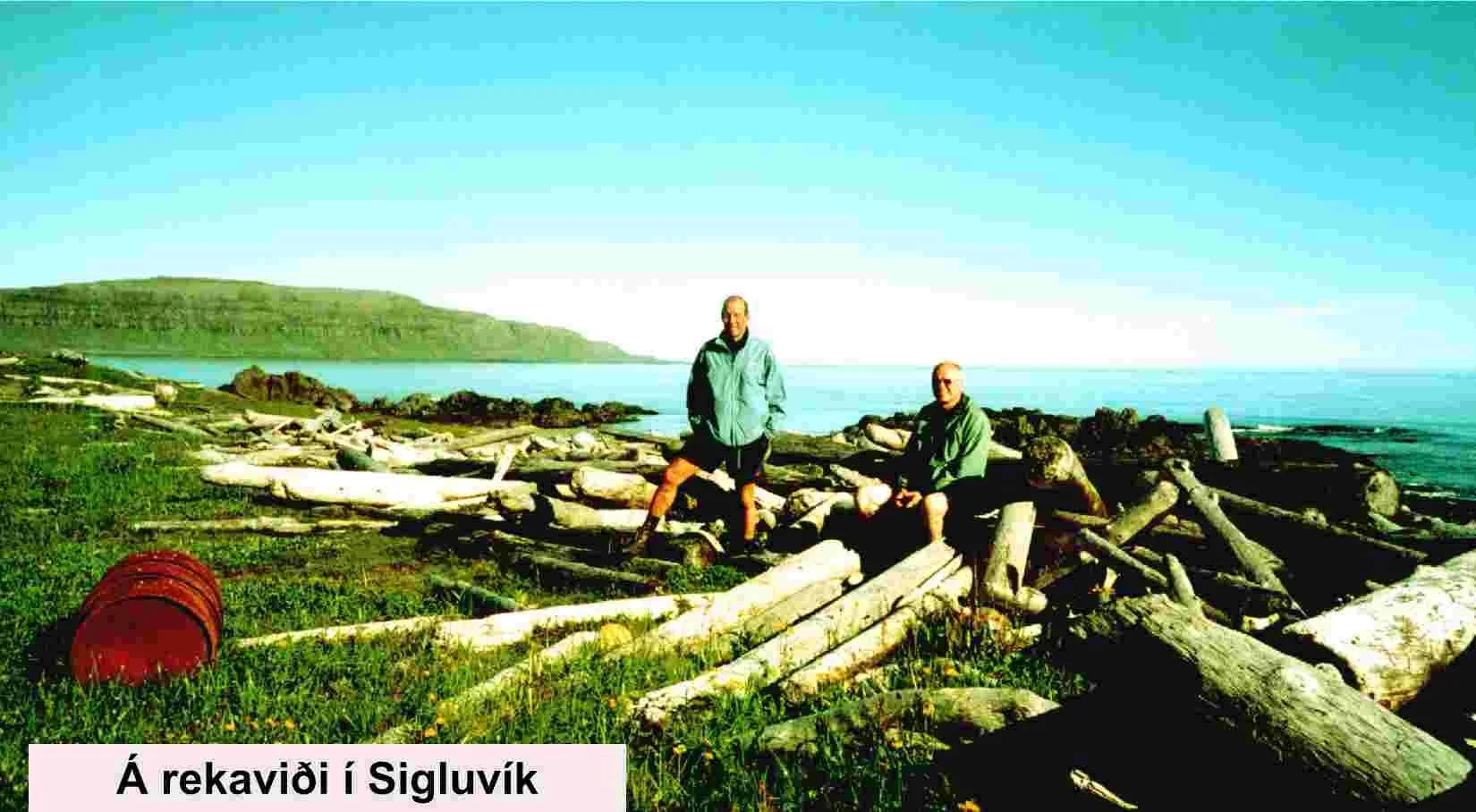
The rest of us continued past Sigluvíkurnúpur, into Sigluvík, and up onto Skjaldarvíkurháls along a good trail. This time we did not descend into Skjaldabjarnarvík but instead climbed directly up Geirhólm.
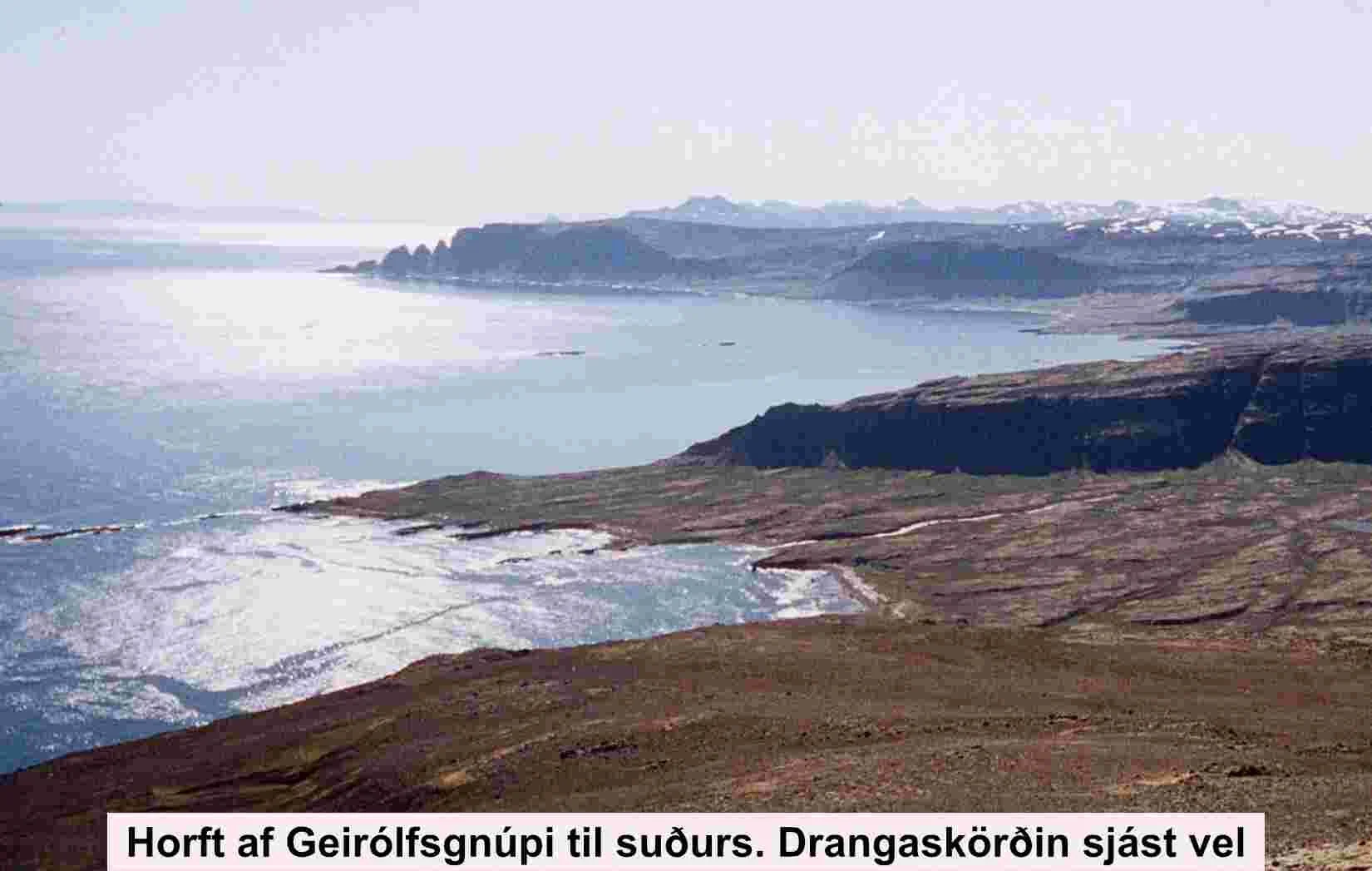
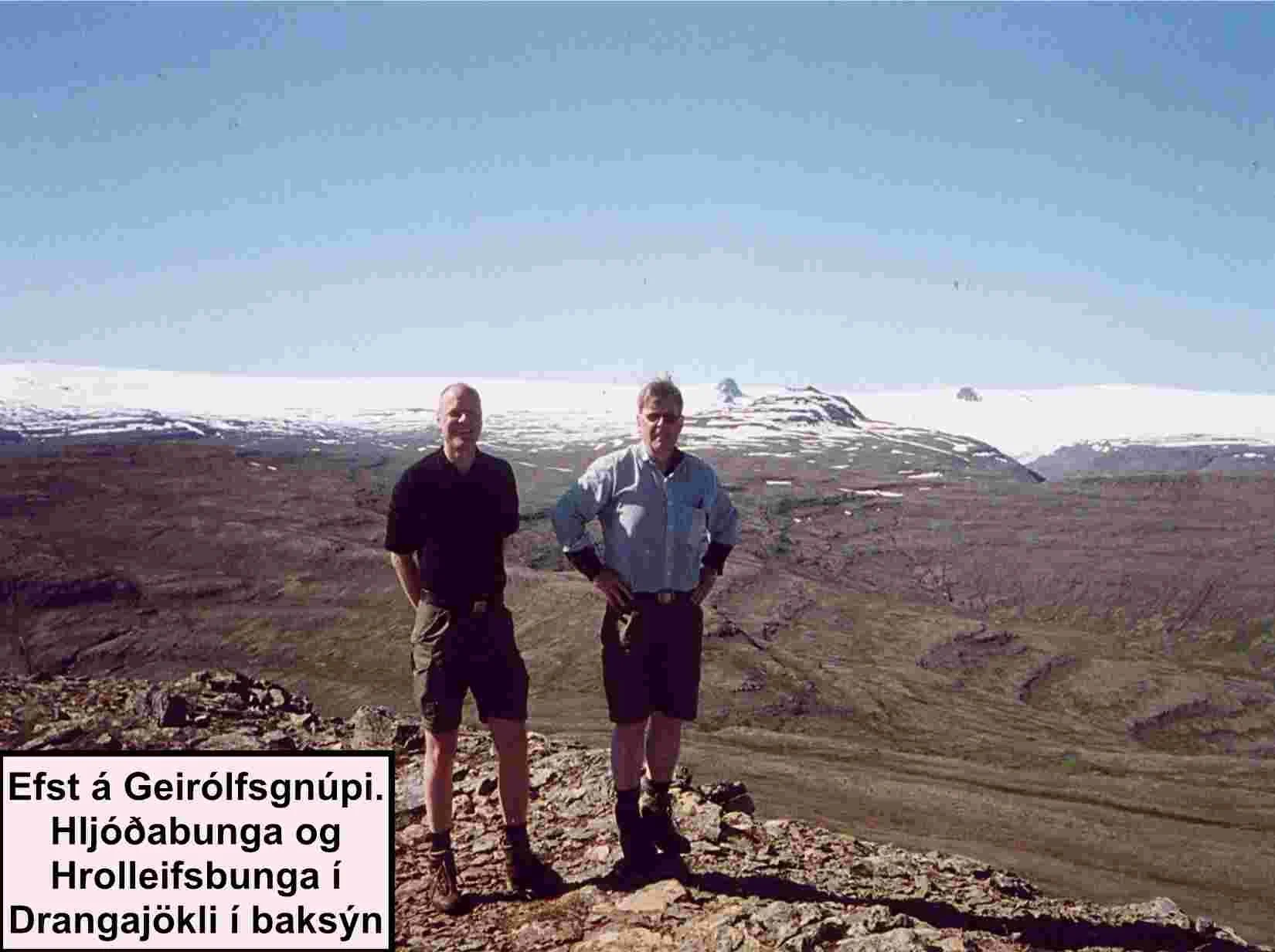
The view from the top was unforgettable. Every fjord from Hornbjarg southward as far as the eye could see was visible. All of Drangajökull was bathed in sunshine, with Hrolleifsborg, Hljóðabunga, and Jökulbunga rising from the ice cap. To the east we could see the Skagi peninsula, and farther east the white mountains of Tröllaskagi.
Just south of us lay the famous Drangaskörð and Drangahlíð, while the mountain Rönd barely obscured the farm at Drangar. Below us we could see the rescue shelter and the ruins of the farm at Skjaldabjarnarvík.
Geirólfsgnúpur is among the highest peaks jutting into the sea in all of northern Strandir, at 433 meters, though Hornbjarg itself is 100 meters higher.
When we returned to Reykjarfjörður, we found that Reykjafjarðarós had become a dangerous river in the heat of the day. We had to walk some distance upstream to find a safer crossing. This time we waded almost up to the waist (at least for me, being short-legged), and the current was intimidating. Nevertheless, everything went well and all crossed safely.
We ate, took down the tents, and waited for Sundhaninn. The boat arrived earlier than expected. I had wandered a little up the valley to soak in a natural hot pool (the mud pool) and did not notice the boat’s arrival—nearly becoming stranded. In my opinion this would not have been a disaster, as another trip was available the next day, but understandably it worried my companions. I promised never to do such a thing again.
After a three-hour voyage south along the northern Strandir coast, we landed at Norðurfjörður. The skipper, Björn “Jói” from Ós, then drove Ögmundur to Eyri by Ingólfsfjörður to fetch our car, DíDí 121.
We then drove south through the night toward the drizzle of the capital, Reykjavík, and surrounding districts.
This trip was in every way enjoyable and educational. We learned much from challenging conditions and how best to meet them with the right priorities. We now know even better how to equip and prepare ourselves for multi-day hikes in Iceland’s wilderness.
The next trip will be a hike from Eyri by Ingólfsfjörður north to northern Reykjarfjörður, planned for around the same time next summer. On that journey we will be richer in experience—and hopefully joined by new hiking companions eager to experience this wilderness paradise firsthand.
Karl Valgeir Jónsson
Gengið um Strandir
Gengið um Hornstrandir
Ort í tilefni af sextugsafmæli
Karls Valgeirs,
andlegs leiðtoga og helsta hugmyndafræðings ferðarinnar.
Júlí, tvöþúsund og eitt
gengið skal um Strandir greitt.
Vinir vilja í svaðilferð
valmenni af bestu gerð.
Kalli, navigator ferðar
með galdratæki ýmsrar gerðar
sími, furðutól eitt mikið,
gps-ið ekki svikið.
Ögmundur, sá knái kappi
leiðangurinn hrósar happi
að hafa svona mikinn mann
með í ferð, það veit mín sann.
Þorkell klæddur sparibuxum
hvað er hann eiginlegað hugsum?
Reynir heitir hetja fróm
með Bónuspoka’ á inniskóm.
Þessir eru fírar fjórir
fallegir og hugumstórir.
Haldið er af stað í býtið
Kappar! komið, ykkur flýtið.
Dídí frísar fim á stalli
fjörug gegnir hverju kalli.
Afbragðsmennin stíga inn
fjörgast ferðahugurinn.
Miðstöðin er keyrð á fullu
hún heldur úti eiturdrullu.
Til Hólmavíkur heldur leiðin
loksins Steingrímsfjarðarheiðin.
Í Munda bróður undravagni
aðstoð felst sem er að gagni!
Í úrhelli í Unaðsdal
við eigum fjögurra manna tal:
Er þetta ekki eintóm della?
Eigum við ekki bara’ að skella
okkur bæinn aftur í?
Enginn frétta þarf af því.
En ekki er það hetjudáð
áfanganum skal víst náð!
Grýtt og þokuþrungin leiðin
Dynjandis er þungfær heiðin
löbbum niður í Leirufjörð
ljúft að sjá þar grænan svörð.
Ríf svo af mér skó og skokka
jökulána verð að brokka.
Upp af kulda allir blánum
andskoti’ er mér kalt á tánum.
Kjögum síðan yfrí Kjós
kemur tjaldstaður í ljós.
Brátt úr öðru tjaldi hrotur
heyrast, í hinu Kalli votur
kúldrast ásamt köldum Reyni
verður þeim víst margt að meini.
Á lappir fyrir allar aldir
eru kappar tveir mjög kaldir.
Í hinu tjaldi lúra lengur
Gilli og Ömmi, það er fengur
að sofa vel í þurru tjaldi
það vottað getur Kalli kaldi.
Troðum í oss pastadrasli
á með það í mesta basli.
Pökkum saman höldum inn
heljarlangan Hrafnsfjörðinn.
Vöðum læki stiklum steina
stöðugt má hér manninn reyna
erum blautir inn að beini
brátt við Skorarheiði reyni.
Þaðan yfirí Furufjörð
finnum ekki þurra jörð.
Í þeim leiða Furufirði
fen og lækir eru byrði.
Í skýli loks við finnum skjól
skipbrotsmanna öruggt ból.
Pastadraslið aftur etum
næstum ekki kyngt því getum.
Þurrkum föt á olíuofnum
korter yfir sjö við sofnum.
Eldsnemma við aftur vöknum
Eiginkvenna’ og barna söknum.
Svartaskarðið bratt oss bíður
bossinn gerist ansi síður.
Í miðju skarði ein hetjan grætur
“ég hefði’ ekki átt að fara á fætur,
ég vil komast heim á Nesið
hætta að troða pasta í fésið”.
En galdrasíminn færir fréttir
fáum súpu, það er léttir.
Lyftist andinn, léttist byrði
í lygnum Þaralátursfirði.
Sæl á himni sólin logar
súpuvonin áfram togar.
Í Reykjafjörðinn rakleitt hlaupum
rými tjalds og súpu kaupum.
Etum uns á blístri stöndum
unaðsleg er súpa á Ströndum.
Veltum saddir út frá Erlu
oní sundlaug, sanna perlu.
Pöntum far hjá Bjössa á Hóli
um Húnaflóann er á dóli.
Í Norðurfjörðinn státnar stíma
stórar hetjur, mikil glíma
unnin er við grjótið ljóta
ekki er skott á milli fóta.
Engan skugga á afrek ber
hálfnað er verk þá hafið er.
Því lofa fjórir fræknir gumar
ferð að ljúka næsta sumar.
Kalla Valla vænum færa
vil ég drápu, og kappann mæra.
Hreystimenni harðsoðið
hefur ekkert ofboðið.
Erlendis á mínum ferðum
engan kappa svo vel gerðum
hef ég mætt, svo hugaður
í anda æ ó-bugaður.
Þennan hefur ortan óð
Ögmundur í djöfulmóð.
Orð með rímabeisli bundið
biður forláts fyrir dundið.
Ögmundur Gunnarsson
Löngufit 11
Garðabæ
DíDí veiðibíll kennaranna í Garðaskóla
Walking the Strandir
Walking the Hornstrandir
Composed on the occasion of
the sixtieth birthday of
Karl Valgeir,
the spiritual leader and principalideologist of the journey.
July, two thousand and one
We shall walk across Strandir
at a steady pace.
Friends long for a daring trek,
fine fellows of the very best kind.
Kalli, navigator of the journey,
with magical devices of many kinds:
a phone, a wondrous tool indeed,
and GPS that never lies.
Ögmundur, that sturdy champion,
praises the expedition’s good fortune
to have such a great man
along on the trip — that’s
the honest truth.
Þorkell dressed in his fancy trousers,
what is he really thinking?
Reynir is named a noble hero,
with a Bónus shopping
bag for indoor slippers.
These are the fabulous four,
handsome and great of spirit.
They set off early in the morning:
“Champions! Come on, hurry up!”
Dídí scurries nimbly about,
lively, answering every call.
The excellent men climb aboard,
the travel spirit quickly rising.
The control center is run at full power,
keeping up a steady stream of nonsense.
The route leads toward Hólmavík,
at last, Steingrímsfjarðarheiði.
In brother Mundi’s marvelous vehicle,
help arrives right when it’s needed.
In pouring rain in Unaðsdalur
we have a four-man council:
“Isn’t this just utter madness?
Shouldn’t we simply turn back,
head home again?
No one needs to know about it.”
But that would not be heroic —
the destination must be reached!
Rocky and fog-laden is the route,
the Dynjandi heath is hard to cross.
We walk down into Leirufjörður,
a joy to see the green grass there.
I rip off my shoes and trot along,
forced to splash across glacial rivers.
Soon we’re all blue from the cold —
damn it, my toes are freezing.
We trudge across Kjós,
and finally spot a campsite.
Soon, snores come from one tent;
in the other, Kalli is soaked,
huddling with cold Reynir —
many troubles await them, no doubt.
On their feet forevermore
stand two champions, very cold.
In the other tent, Gilli and Ömmi
sleep longer — a blessing indeed,
sleeping well in a dry tent,
as cold Kalli can attest.
We force down some pasta mush,
eating it with great difficulty.
We pack up and head inward,
across the immense Hrafnsfjörður.
We wade streams, hop stones,
constantly testing our mettle.
Soaked to the bone,
we soon struggle at Skorarheiði.
From there on to Furufjörður,
not a patch of dry ground to be found.
In that miserable Furufjörður,
bogs and streams are a burden.
At last we find shelter,
a safe haven for shipwrecked souls.
We eat the pasta mush again,
nearly unable to swallow it.
We dry our clothes by oil heaters,
and fall asleep at quarter past seven.
At dawn we wake again,
missing wives and children.
The steep Svartaskarð awaits us,
the going becomes rather grim.
In the middle of the pass,
one hero weeps:
“I should never have gotten up,
I want to go home to Nesið,
stop stuffing pasta into my face.”
But the magic phone brings news:
we’ll get soup — what a relief!
Spirits lift, burdens lighten
in the calm of Þaralátursfjörður.
The sun glows happily in the sky,
the promise of soup pulls us onward.
We run straight into Reykjafjörður,
rent tent space and buy soup.
We eat until bursting —
the soup in Strandir is divine.
Satisfied, we roll out from Erla’s place
into the swimming pool, a true gem.
We order passage with Bjössi at Hóll
who sails across Húnaflói.
Toward Norðurfjörður the struggle rises —
great heroes, a mighty contest.
The ugly rocks are conquered,
no tails tucked between legs.
No shadow dims the achievement:
half the work is done once begun.
Thus four valiant men vow
to finish the journey next summer.
To dear Kalli Valli
I wish to offer this poem
and praise the champion.
A tough, hard-boiled man,
nothing has overwhelmed him.
On my travels abroad,
I have met no hero so well made,
so courageous,
in spirit forever unbroken.
This ode was composed
by Ögmundur in devilish mood.
Words bound in the bridle of rhyme,
asking forgiveness for the mischief.
Ögmundur Gunnarsson
Löngufit 11
Garðabær